If you're asking what is iGaming white label, you've probably already worked out that launching an online betting operation is no longer an informal side project — it's a regulated, technology-heavy, competitive business. The question that remains is always the same: build everything yourself, or use a ready-made platform that has already solved the hard part?
This guide breaks down the white label model — what it is, who holds the licence, what it costs, what the contract terms that matter actually say, and how it compares with the other ways into the market. By the end you should be able to tell whether white label is the right entry point for your project, or whether turnkey, a self-service platform, or building in-house fits your situation better.
What does "white label" mean?
The term white label describes a product built by one company and sold by another under that second company's brand. The concept didn't originate in iGaming — it's standard in credit cards, SaaS, and supermarket private-label goods. The logic is always the same: whoever owns the technology stays invisible, and whoever puts their brand on the front captures the relationship with the end customer.
Translated into betting: a white label betting platform is a complete sportsbook and online casino solution that you configure with your name, your visual identity and your commercial rules, then launch as if it had been built in-house. The player who signs up, deposits and plays sees only your brand. The engineering, the game integrations, the payment processing and the backoffice stay with the provider.
In practice, white label separates two things that are constantly conflated: owning the brand and owning the infrastructure. Under this model you own the brand, the strategy and the player relationship, while the infrastructure is delivered as a service.
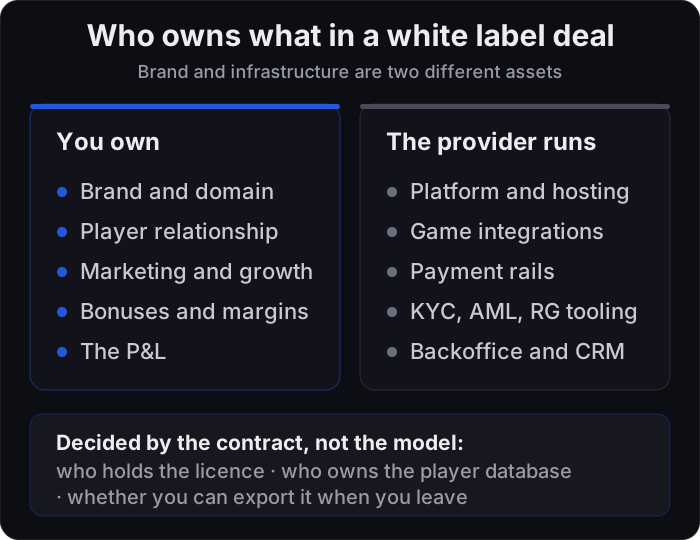
That split is what makes it possible to launch fast and with a much smaller upfront investment than any other path. It's also where the model's limits come from, which is why the rest of this guide spends more time on the contract than on the feature list.
Who holds the gambling licence?
This is the question that most "what is white label" explanations skip, and it's the one that actually separates the models. In marketing material the answer is usually a vague "the provider handles licensing." In reality there are three distinct arrangements, and which one you're in changes your legal exposure, your costs and your ability to leave.
The provider's licence covers you. The provider holds a B2C licence and you operate as a white label partner under it, governed by a formal operator agreement. You get to market without your own licensing process. In exchange, you typically cannot hold player funds directly — all money moves through the licensee — and you inherit the provider's regulatory standing, including any trouble it runs into.
You hold your own licence. The provider supplies technology, and the authorisation is yours. This costs more and takes longer, but the operation is legally yours and you are not exposed to a third party's compliance record. Several regulated markets require this and simply do not recognise licence-sharing.
Co-branded. Both brands appear on the licence. It's the fastest arrangement to set up and it consistently has the weakest exit terms — the provider often retains rights over the player database.
What changed in 2025
For years the default answer was Curaçao: four private master licence holders sold sub-licences, and a white label operator ran under one of them. That route is closed. The National Ordinance on Games of Chance (LOK), in force since 24 December 2024, abolished the master/sub-licence system entirely; legacy sub-licences expired in January 2025, and the Curaçao Gaming Authority now licenses and supervises each operator directly.
The practical effect is that a lot of the white label advice still circulating online describes a structure that no longer exists. Anjouan has absorbed much of that demand and does support the model explicitly — the licensee must hold both B2B and B2C authorisations, a formal agreement is required per white label partner, the partner cannot handle funds directly, and KYC on the partner plus proof of domain ownership are mandatory. Tier-one jurisdictions such as Malta permit white label arrangements but keep full regulatory responsibility with the licensee, which makes them far more selective about partners.
Regulated national markets are stricter still. In Brazil, for example, authorisation from the SPA/MF is issued to the operating company itself — a platform provider cannot lend you its licence, no matter what the model is called. There, white label means technology and compliance tooling, and the licence remains your own responsibility.
What to do with this: before comparing feature lists, get a written answer to three questions — which entity holds the licence, which jurisdiction issued it, and what happens to your operation if that licence is suspended.
How a white label platform works in practice
Picture what happens when a player uses your site. They land on a domain carrying your brand, create an account, deposit, pick a casino game or a sports bet, and eventually request a withdrawal. Each step triggers a chain of processes the platform runs behind the scenes.
A complete white label stack provides:
- Sportsbook with real-time odds across thousands of markets, plus the risk management and trading layer behind them
- Casino with titles aggregated from multiple studios — slots, live dealer, and crash games
- Payment orchestration across the methods each target market actually uses
- Player account management (PAM) — the wallet, the account lifecycle, the single source of truth for player state
- CRM for segmentation, campaigns, bonuses and retention
- Backoffice with administrative and financial reporting
- Affiliate system with flexible commission structures
The components worth inspecting
Game aggregation. A competitive casino doesn't run on one supplier. The platform needs a game aggregator layer integrating multiple studios, because catalogue breadth is a retention lever and each direct integration is weeks of work you'd otherwise do yourself.
Payment orchestration. Depending on a single gateway is a live revenue risk: if it goes down or starts declining, players can't deposit. Serious platforms run multiple gateways with automatic fallback per method.
The wallet. Ask specifically whether the platform uses a seamless wallet — a single balance across sportsbook and casino — or separate wallets per vertical. It sounds like a technical detail; it directly shapes the player experience and your cross-sell economics.
Compliance tooling. KYC, AML routines and responsible gaming controls such as deposit limits, reality checks and self-exclusion. In any regulated market these are the baseline for operating legally, not optional modules.
Affiliates and sub-affiliates. Growth in iGaming runs heavily through affiliate marketing, so a full commission system — including a sub-affiliate tier — determines how far your partner network can scale.
What white label actually costs
Almost every explanation of this model says "lower upfront cost" and then gives no numbers. Providers rarely publish rate cards, but advertised pricing across the market clusters into recognisable ranges.
| Cost line | Typical advertised range | What moves it |
|---|---|---|
| Setup fee | US$15,000 – 150,000+ | Scope, number of markets, custom front-end work |
| Monthly platform fee | US$2,000 – 15,000 | Support tier, modules, traffic volume |
| Revenue share | 10 – 30% of GGR or NGR | Inversely related to setup and monthly fees |
Three things to hold onto when reading those numbers.
The levers trade against each other. A provider advertising a very low setup fee is almost always recovering it through a higher revenue share. Compare total cost over a realistic 24-month projection, not the entry price.
Confirm the revenue-share base. A percentage of GGR and the same percentage of NGR are materially different amounts, because NGR is net of bonuses, affiliate commissions and payment fees. Get in writing which one applies and exactly what is deducted before it.
The platform is rarely the biggest line. Licensing, the corporate structure, payment processing fees, game content royalties where they're billed separately, and above all marketing typically dwarf the platform cost. Our full cost breakdown for launching a betting platform works through those lines against the build-it-yourself alternative.
Watch for costs that don't appear in the headline: additional gateway integrations, extra languages or currencies, custom reporting, dedicated account management, and per-player compliance charges in some regulated markets.
The fine print: player data, exit and lock-in
Two contract terms matter more than anything on the feature list, and both only become visible when you try to leave.
Who owns the player database?
Most providers will tell you the operator owns the player data, and most contracts say so. But ownership on paper and portability are different problems: the data lives in the provider's infrastructure, in their schema, and getting it out in a usable state is a separate capability from being entitled to it.
What to require in writing: a complete, structured export of player accounts, current balances, full transaction history, bonus and wager states, and KYC records and verification status — in a documented format, delivered within a defined timeframe, at a defined cost. If the agreement guarantees ownership but says nothing about export mechanics, you have a right you can't exercise.
Co-branded arrangements deserve extra scrutiny. When the provider's brand sits on the licence alongside yours, they frequently retain rights over the player relationship itself, not just custody of the records.
What happens when you leave
Migration is the hardest part of any platform project, and most operators discover the constraints at exit rather than at entry. A realistic migration has to reconcile player balances to the cent, transfer KYC records so verified players aren't forced through verification again, carry over open bonuses and wagering requirements, and preserve game history for audit and dispute handling.
Negotiate the exit before you sign: notice period, export format and scope, transition support obligations, what happens to funds held on the licensee's accounts, and whether there's an exclusivity or non-compete clause that constrains where you can go. The market has been moving toward clearer exit paths and more modular contracts — which means these terms are negotiable, and asking for them is normal rather than adversarial.
White label sportsbook vs. white label casino
These are frequently sold as one package but they are different products with different economics, and plenty of operators end up strong in one and weak in the other.
Casino is largely a content and merchandising problem. The platform aggregates studios, and your job is catalogue curation, bonus design and lifecycle marketing. Margin is predictable because RTP and house edge are fixed per title. Most white label providers are genuinely competent here, because aggregation is a solved problem.
Sportsbook is an operations problem. Behind the odds sits a data feed, a pricing model, a trading team and a risk management layer that decides limits, spots arbitrage and handles suspicious patterns. Margin is volatile — a bad weekend of results is a real financial event. This is where white label offerings diverge most sharply in quality, and where you should ask the hardest questions: whose feed, who sets limits, who carries the liability on a losing month, and can you adjust margins per market yourself.
If sports is central to your plan, evaluate the sportsbook on its own merits rather than accepting it as a bundled extra. The GGR mix between the two verticals varies enormously by market and should drive which side you scrutinise.
Payments: what the operation actually needs
Payments are where a technically sound platform most often fails commercially, because the requirements are local and change per market.
Cards and e-wallets travel almost everywhere, but the method that dominates each market is usually a domestic instant-payment rail: PIX in Brazil, UPI in India, Interac in Canada, open-banking transfers across much of Europe, mobile money in parts of Africa. Crypto is significant where it's permitted and prohibited where it isn't. A platform that supports the wrong list for your market is a platform you'll be fighting for as long as you run it.
Beyond the method list, three things separate a payments layer that works from one that leaks revenue:
- Redundancy. Multiple gateways per method with automatic fallback, so a single processor outage doesn't stop deposits. This matters more than any individual integration.
- Withdrawal speed. Payout latency is one of the strongest drivers of player trust and one of the most common reasons players churn to a competitor.
- Reconciliation. Financial reporting that ties deposits, withdrawals, chargebacks and game activity into numbers you can actually close a month on.
Our guide to payment systems and gateway architecture goes into the mechanics, including how fallback logic and financial KYC work in practice.
Advantages of the white label model
Speed to launch. Every month spent building is a month competitors spend acquiring players. Instead of waiting more than a year for a product, you enter the market quickly and start testing brand, channels and retention with real players.
Lower upfront cost. Building from scratch requires an engineering team, expensive integrations, and months of payroll before the first unit of revenue. White label converts a heavy, uncertain capital investment into a predictable operating cost — and the capital you free up can go into acquisition.
Proven technology. You operate on a stack already tested in production across other operations. You're not discovering payment bugs and integration failures with real players' money on the line.
Compliance tooling included. Having KYC, AML and responsible-gaming controls already built and maintained means you're not constructing that layer yourself while a regulator waits.
Focus. While the platform handles technology, your energy goes to what differentiates the operation: brand, player experience, acquisition channels and affiliate network.
Disadvantages and limits
No model is free of trade-offs, and presenting only the upside would be dishonest.
- Less control over the roadmap. The technology belongs to the provider, so you depend on their priorities for new features and their pace for fixes. A feature critical to you may never be critical to them.
- Customisation has limits. You shape brand, identity and commercial rules; deep changes to the product's engineering are usually out of reach.
- Provider dependency. Your operation's quality, uptime and — in licence-sharing arrangements — regulatory standing are tied to theirs.
- Shared margins. Revenue share means the provider earns on every unit you earn, permanently. At low volume that's excellent value; at high volume it becomes the main argument for moving to turnkey or in-house.
- Switching costs are real. As covered above, migration is difficult and the difficulty is discovered late.
None of this invalidates the model. It sets the boundary: white label is strongest when speed and capital efficiency matter more than control, and weakest once your volume makes the revenue share expensive relative to running your own stack.
White label vs. turnkey vs. self-service vs. in-house
When people research white label vs turnkey, they're trying to work out how much control and responsibility each model puts on them. There are four paths, not two.
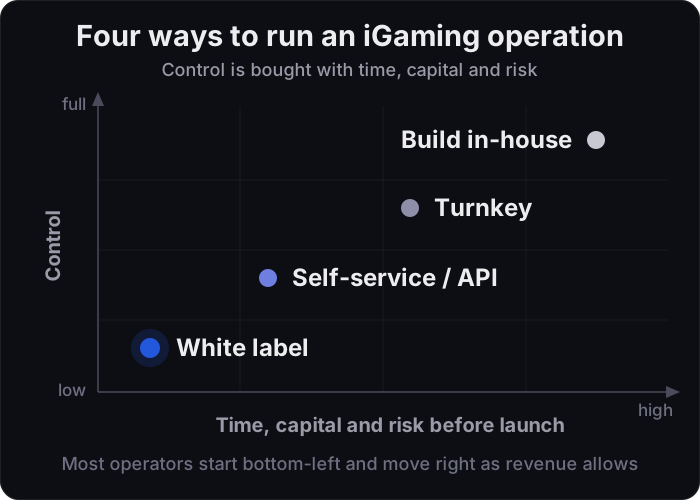
In white label, the provider handles nearly everything — technology, payments, compliance tooling, and in some jurisdictions the licence — and you operate under your own brand with the smallest possible technical and regulatory footprint.
In self-service or API-only, you license platform components and assemble the front end, and sometimes the wallet, yourself. Cheaper in fees and more flexible in product, but it requires real engineering capacity in-house.
In turnkey, you receive a ready-built platform but carry more of your own obligations — typically your own licence, direct contracts with some suppliers, and more control over configuration. You gain autonomy and better economics at scale, at the cost of complexity and setup time. We cover what a turnkey arrangement includes separately.
In building in-house, you build from the ground up with an internal engineering team. Total control, paid for in money, time and risk.
| Criterion | White label | Self-service / API | Turnkey | In-house |
|---|---|---|---|---|
| Time to launch | Hours to weeks | Weeks to months | Weeks to months | 12–18 months |
| Upfront investment | Low | Low to medium | Medium to high | Very high |
| Control over the product | Low to medium | Medium | Medium to high | Full |
| Licence | Provider's or yours, by jurisdiction | Yours | Normally yours | Yours |
| Compliance responsibility | Largely the provider's | Shared | Shared, mostly yours | Entirely yours |
| Ongoing cost model | Revenue share + fees | Fees, lower share | Fees, lower share | Payroll and infrastructure |
| Technical team needed | None | Small engineering team | Reduced | Large |
| Best fit for | Entering and validating fast | Product-led operators with developers | Operators with their own structure | Large players with scale |
The read is straightforward: the more control you want, the more time, money and risk you take on. White label offers the shortest time to launch, the lowest upfront investment and the lowest technical risk, at the cost of control and a permanent share of revenue. In-house only pays off once your scale justifies building and maintaining everything — and those 12 to 18 months of development are months of lost market opportunity.
How long a launch really takes
"Live in hours" is a claim about infrastructure, and it's true of mature platforms — but it is not a claim about your business being open. Two tracks run in parallel, and the platform is almost never the slow one.
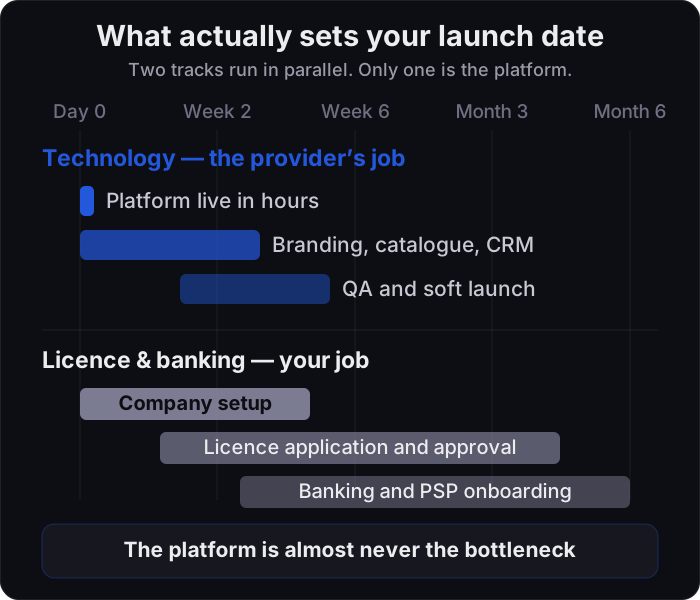
On the technology track, a provider-hosted instance can be running the same day. Branding, domain, front-end configuration, catalogue curation, bonus rules and CRM setup add days to a few weeks depending on how prepared your assets and commercial decisions are.
On the licence and banking track, you're incorporating an operating company, going through a licence application or being formally added to a licensee's partner list, and onboarding with banks and payment providers — which run their own due diligence on gambling merchants and are frequently the single slowest step. This track runs for months in most jurisdictions.
The honest summary: white label removes the technology track from your critical path almost entirely, and does nothing about the other one. That's still a large win — it's the difference between a regulatory timeline running in parallel with a finished platform and one running in parallel with a development project — but plan the calendar around licensing and banking, not around go-live speed on a sales deck. Our step-by-step launch guide sequences both tracks in detail.
Operating in a regulated market
Regulated markets change the calculation in the model's favour, with one important caveat.
The favourable part: regulated markets impose long lists of technical obligations — identity verification, source-of-funds checks, AML monitoring and reporting, deposit and loss limits, self-exclusion registers, session reminders, data protection, and audit trails for all of it. Building that layer to the standard a regulator will accept is a substantial project on its own, and it never finishes, because the rules keep moving. A mature platform carries these tools built in and updates them as regulation evolves, which reduces the risk of falling out of compliance over a technical detail.
The caveat: in most regulated national markets, the platform does not replace the licence. Brazil is a clear example — the market has been regulated since 2025 under Law No. 14,790/2023 and rules issued by the Secretariat of Prizes and Betting at the Ministry of Finance (SPA/MF), and authorisation is granted to the operating company, which must be locally incorporated and prove financial capacity. The platform makes you technically ready to deliver what you promised the regulator; it does not make you licensed. The same pattern holds across most tier-one markets. Our guide to Brazil's regulatory framework works through one market's requirements in full, and the structure generalises reasonably well.
None of this is legal advice — licensing decisions need specialist counsel in the specific jurisdiction.
Who white label is a good fit for
- Entrepreneurs entering iGaming without a technical team.
- Affiliates who already understand acquisition and want to capture the player's full revenue instead of a commission — the move from affiliate to operator is one of the most common paths into the model.
- Operators unhappy with a current platform, looking for more stability, more content or more reliable payments.
- Companies from other sectors diversifying into betting by leveraging an existing audience or brand.
- Established operators entering a new market, where white label is a low-risk way to test demand before committing local infrastructure.
It's a poor fit when your product itself is the differentiator — a novel game mechanic, an unusual bonus engine, a distinctive front-end experience — because those are exactly the things you can't change. It's also a poor fit at high volume, where the revenue share starts costing more than an engineering team.
How to choose a white label provider
Once the model makes sense, the provider decision is what determines the outcome. Beyond the obvious checks on catalogue and uptime, the questions that actually separate a serious platform from a fragile one:
- Licence structure. Which entity holds it, which jurisdiction, and what happens to you if it's suspended.
- Player data and exit terms. Guaranteed export scope, format, timeframe and cost — in the contract, not the pitch.
- Total cost over 24 months. Setup, monthly, revenue share and the base it applies to, plus every add-on that isn't in the headline number.
- Payment redundancy for your specific target market, with named gateways and a fallback that has been tested.
- Sportsbook quality specifically, if sports matters to you — feed, trading, risk limits and who carries liability.
- Compliance depth against the regulations you'll actually be subject to, not a generic feature list.
- Support that responds. Ask for response-time commitments in writing and speak to an existing operator on the platform.
- A concrete launch timeline, broken into the technology track and the regulatory track separately.
We've written a longer framework for comparing white label platforms before signing, and a companion guide on what to look for during a platform demo — the demo is where most of the questions above get answered honestly or evaded.
Where Nodrus fits
Deciding whether to build, go turnkey or go white label comes down to how much time, capital and risk you're willing to spend before your first player deposits.
Nodrus is a white label iGaming platform built against the criteria above: a complete stack with sportsbook, casino, CRM, affiliate system and backoffice; more than 16 integrated game providers; 4 payment gateways with automatic fallback; native PIX for the Brazilian market alongside international methods; KYC, AML and responsible-gaming tooling built in; a sub-affiliate structure; 24/7 support; and infrastructure that can go live in as little as 4 hours.
Set against 12 to 18 months of in-house development, that gap is the whole argument for the model — it lets you enter the market with controlled technical risk and capital preserved for the things that actually decide the outcome: your brand, your players and your acquisition.
Still choosing between white label, turnkey, or in-house?
See exactly what Nodrus delivers ready to go — infrastructure live in 48 hours.
Get a free demo